
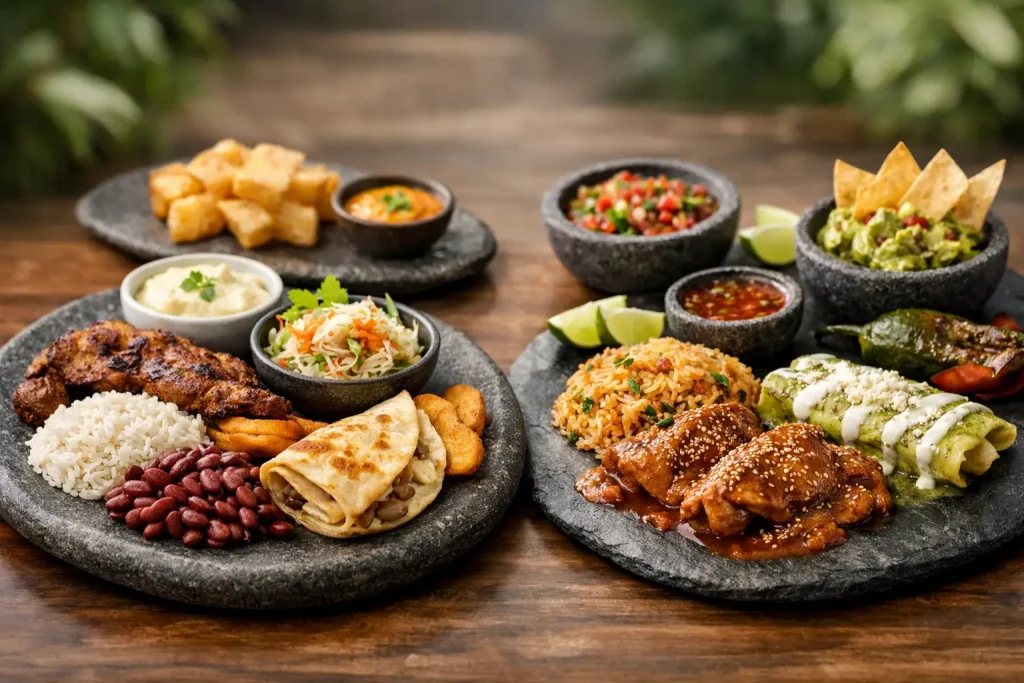
A warm baleada folded around creamy beans and fresh queso can tell a very different story from a corn tortilla carrying slow-braised meat and a bright chile salsa. That is the pleasure of considering Honduran food versus Mexican food: the cuisines share foundational ingredients and a deep respect for the table, yet their flavors, textures, and signature dishes express distinct histories.
For diners who know Latin American cuisine mainly through familiar Mexican dishes, Honduran cooking can feel like a welcome revelation. It is generous, comforting, and ingredient-driven, with beans, plantains, cheese, tropical fruit, corn, and seafood appearing in thoughtful, satisfying combinations. Mexican cuisine is equally layered, but its enormous regional range and celebrated vocabulary of moles, salsas, masa preparations, and chiles create a different kind of culinary map.
Honduran Food Versus Mexican Food Starts With Place
Neither cuisine should be reduced to a single flavor profile. Mexico contains many culinary regions, from coastal seafood traditions to the complex sauces of Oaxaca and the grilled meats of the north. Honduras also has meaningful regional differences shaped by its Caribbean coast, fertile valleys, Indigenous heritage, Garifuna communities, and Spanish colonial influence.
Still, place leaves an immediate mark on the plate. Honduran cooking often carries the ease of a tropical landscape. Coconut, yucca, green and ripe plantains, fresh cheese, beans, and seafood are central to many beloved dishes. On the northern coast, coconut milk may bring softness and fragrance to soups and rice, while seafood reflects the proximity of the Caribbean.
Mexican food is also coastal in many regions, but it is especially renowned for the breadth of its chile culture and the technical depth of its corn cookery. Masa is more than an ingredient. It is the starting point for tortillas, tamales, sopes, tostadas, tlacoyos, and countless regional expressions. Corn matters deeply in Honduras as well, particularly in tortillas, tamales, and drinks, but wheat flour has a particularly iconic role in one of the country’s best-known foods: the baleada.
The Ingredients They Share, and Use Differently
Beans, corn, tomatoes, peppers, herbs, cheese, avocado, pork, chicken, and rice appear across both cuisines. The difference is not whether these ingredients are present. It is how they are seasoned, prepared, and balanced.
In Honduras, refried red beans are often smooth, rich, and comforting rather than heavily spiced. They are a natural partner for eggs, crema, avocado, and queso fresco. Honduran cheeses tend to be fresh, tangy, and pleasantly salty, contributing a dairy-rich finish to breakfast plates, antojitos, and soups. Plantains are equally important. Green plantains may be fried into crisp tostones, while ripe plantains become sweet and caramelized, creating contrast beside savory beans or grilled meats.
Mexican cooking uses beans in many forms, from whole pot beans to black beans and refried pinto beans, but the supporting cast can shift dramatically by region. Fresh salsas, dried chile sauces, tomatillos, epazote, cumin in certain regions, and aromatics such as onion and garlic can give a dish a sharper or more layered profile. Cheese may be crumbled, melted, stretched, or baked into a dish, depending on the style of cooking.
Heat is one area where assumptions can get in the way. Honduran food is not simply “mild Mexican food.” Many Honduran dishes use peppers, pickled vegetables, hot sauces, and deeply seasoned proteins. The heat, however, is often offered as a complement rather than defining every bite. Mexican cuisines feature an exceptionally wide spectrum of chiles, ranging from earthy and fruity to smoky and intensely hot. In both traditions, spice should bring character, not erase the ingredients beneath it.
Baleadas and Tacos Tell Different Stories
If one dish introduces Honduran cuisine beautifully, it is the baleada. At its simplest, it is a large, soft flour tortilla folded around refried beans, crema, and queso. From there, it can become more substantial with eggs, avocado, plantains, shredded meat, or other additions. The appeal is in its quiet perfection: warm flour tortilla, velvety beans, cool crema, and fresh cheese in every folded bite.
A taco is not one fixed dish, which is exactly why it is so expressive. It may begin with a soft corn tortilla or, in some traditions, flour. Its filling might be grilled meat, braised meat, fish, vegetables, mushrooms, or beans. Then come the details: onion, cilantro, salsa, lime, radish, pickled vegetables, and regional sauces. A taco often invites each diner to build the final balance of acidity, heat, and texture.
Both dishes are hand-held, social, and deeply satisfying. Yet the baleada leans into creaminess and comfort, while many tacos highlight contrast: tender filling against a supple or crisp tortilla, rich meat lifted by lime, or a smoky salsa cutting through fat. Neither is more authentic or more refined. They simply reveal different instincts at the table.
Soups, Seafood, and Slow-Cooked Comfort
Honduran soups deserve special attention because they reveal the cuisine’s generosity. Sopa de caracol, often made with conch where available, is known for its coconut-based broth, herbs, vegetables, and maritime richness. Other Honduran soups may feature beef, chicken, seafood, yucca, corn, squash, cabbage, and plantains. They are full meals, built for lingering and sharing.
Mexican soups and stews carry their own powerful range. Pozole, menudo, birria, tortilla soup, and regional seafood broths can be bright, chile-forward, herbal, deeply savory, or all of those at once. Hominy, dried chiles, roasted vegetables, and long-simmered broths often create layers that unfold slowly.
The comparison is useful because it highlights a shared Latin American love of food that nourishes beyond the first course. A proper soup is not an afterthought. It is a vessel for memory, seasonality, family, and patience.
Sauces Create a Different Rhythm at the Table
Mexican cuisine is widely associated with sauces for good reason. Salsa verde, salsa roja, mole, adobo, pipián, and countless regional preparations show how a sauce can be the heart of a dish. Chiles may be roasted, dried, toasted, soaked, blended, fried, or simmered. The result can be fresh and lively or dark, complex, and deeply concentrated.
Honduran tables often bring a different but equally inviting rhythm. Creamy elements, fresh cheese, pickled onions or vegetables, hot sauce, and bright citrus may sit beside the main dish. Chismol, a fresh chopped condiment often made with tomato, onion, cilantro, and citrus, offers a clean, refreshing contrast to grilled meats and fried foods. The flavors frequently feel direct and sunlit, allowing the quality of the beans, plantains, seafood, or protein to remain clear.
For a guest deciding what to order, this can be a helpful guide. Choose Honduran-inspired dishes when you are craving rounded, comforting flavors with tropical notes and satisfying textures. Choose Mexican-inspired dishes when you are drawn to chile complexity, bright salsas, and the endless versatility of masa. Of course, the best meal may be one that brings both traditions into conversation.
Why the Comparison Matters on a Modern Latin Table
Latin cuisine is sometimes treated as one broad category, flattening countries and communities into a few familiar dishes. A more thoughtful approach honors the specific ingredients, techniques, and stories that make each tradition distinct. It also leaves room for chefs to create respectfully, pairing heritage with seasonality, presentation, and personal expression.
At Catrachos Latin Cuisine, that conversation is part of the experience. Honduran roots can meet influences from Mexico, Peru, Spain, and the wider Latin American table without losing their identity. A chef-driven menu has the opportunity to highlight a familiar ingredient in an unfamiliar way: a plantain prepared with greater finesse, a fresh cheese used for contrast, or a bright salsa placed beside a dish that calls for its energy.
For guests with gluten sensitivities or celiac disease, both cuisines can offer naturally gluten-free possibilities through corn, beans, rice, vegetables, and fresh proteins. But ingredients and preparation methods matter. Flour tortillas, breading, shared fryers, sauces, and cross-contact can change a dish’s suitability, so a conversation with the service team is always the right first step.
The most rewarding way to approach Honduran and Mexican food is with curiosity rather than a scorecard. Order the baleada because its simplicity is deliberate. Taste the salsa because its chile has a story. Let the plantain, the masa, the beans, and the broth show you how many ways a table can feel like home.